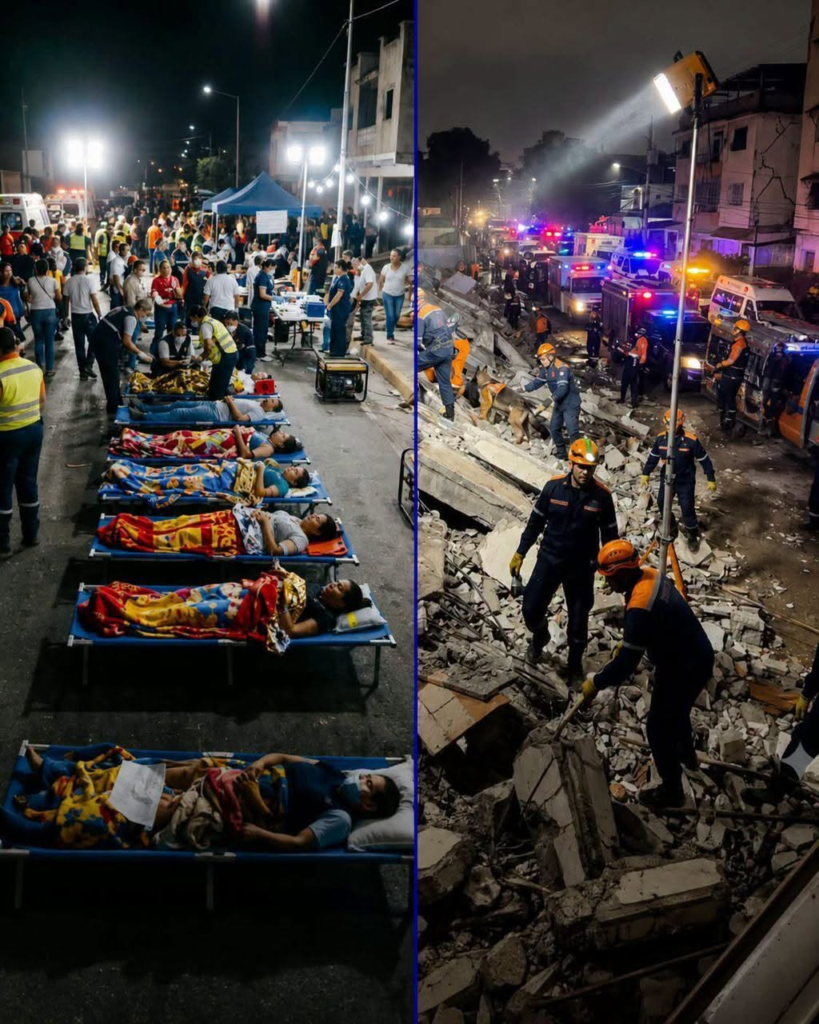
Magnitude 7.4 earthquake shakes Colombia: more than 100 dead, buildings collapsed and airports affected
Colombia is going through one of the most painful days in recent years after a powerful 7.4 magnitude earthquake shook large regions of the country on Monday, August 10, causing buildings to collapse, serious damage to infrastructure, disruptions at airports and a number of victims that continues to rise as rescue teams advance through the rubble.
The earthquake struck in the morning, with its epicenter near San José del Palmar, in the Chocó department of western Colombia. The tremor was strongly felt in cities such as Cali, Pereira, Manizales, Armenia, and Quibdó, as well as in other parts of the country and neighboring regions.
Initial reports indicated around twenty deaths. However, as emergency services gained access to the worst-affected areas, the magnitude of the tragedy began to become clear.
Hours later, the Associated Press reported at least 111 deaths , while other tallies compiled throughout the day provisionally raised the death toll to 132, with approximately 570 injured . Because search efforts continue under collapsed structures, authorities warn that these figures may still change.
The earthquake surprised millions during the morning
The strong movement occurred as millions of Colombians were beginning their usual activities.
Within seconds, homes, office buildings, shops, and other structures began to shake violently.
People in tall buildings quickly descended to streets and open spaces, while alarms and sirens began to be heard in different cities.
The force of the earthquake also caused disruptions in communications in some areas, complicating the possibility of obtaining an accurate picture of the emergency during the first few hours.
Videos circulating from different cities showed people gathered in streets and parks while awaiting instructions from authorities and observing the damage caused to various structures.
The epicenter was in Chocó
Reports about the movement placed the epicenter near San José del Palmar , an area in the department of Chocó.
The earthquake was powerful enough to be felt hundreds of kilometers away.
Cities such as Pereira, Cali, Manizales and Quibdó are among the locations where significant damage was reported.
It was also detected in Bogotá, Medellín, Armenia, Popayán and other regions of the country.
The wide geographical reach of the earthquake meant that social media was flooded with messages from citizens trying to contact family members practically from the first few minutes.
Pereira, one of the hardest-hit areas
Initial reports already indicated Pereira as one of the cities with the highest number of victims.
During the first few hours, Reuters reported that at least 18 deaths had been confirmed there, while the national death toll was still around 20.
The situation subsequently continued to evolve.
Various structures suffered damage and emergency services began working in buildings where there was a possibility of finding people trapped.
Firefighters, police, medical personnel, Civil Defense and volunteers were deployed to the affected areas.
The priority was to locate survivors.
Buildings completely collapsed
One of the most worrying aspects of the emergency is the number of structures affected.
The reports gathered during the day spoke of more than 1,500 buildings with some level of damage and dozens of structures completely collapsed .
A tally released during the day placed the number of completely collapsed buildings at at least 61.
These figures explain why the search operations could be prolonged.
When a building collapses, removing the debris needs to be done with extreme care.
A heavy machine used incorrectly can displace elements that maintain empty spaces where survivors could eventually exist.
Therefore, specialized teams are advancing slowly while using tools, cameras, sensors and other available resources to search for signs of life.
Cali also reported serious damage.
Cali is among the cities hit by the earthquake.
Reports indicated multiple fatalities and significant structural damage, as emergency teams responded to different locations simultaneously.
The Associated Press reported that in Cali alone, dozens of victims had been counted during the reports available throughout the day.
The situation generated additional concern due to the city’s urban density and the number of people present in residential and commercial buildings at the time of the movement.
After the earthquake, many people remained outside their homes for hours for fear of possible aftershocks.
Manizales reports damage and casualties
Manizales was another city where the movement caused serious consequences.
Initial reports indicated deaths and damage to various structures.
Damage to major buildings in the city was also reported.
As happened in other parts of the country, residents temporarily left buildings while specialized personnel began inspections.
After a major earthquake, a structure may appear to remain standing and yet have suffered internal damage that compromises its stability.
For that reason, the authorities recommend avoiding re-entering seriously affected properties until they have been assessed.
Airports affected by the earthquake
The emergency also impacted air transport.
Several regional airports had to suspend or restrict operations while runways, terminals, and other facilities were inspected.
Among the cities mentioned in the reports of impacts are Cali, Pereira, Manizales, Quibdó, Armenia, Cartago and Buenaventura .
The suspension of operations does not only affect passengers.
In the midst of a large-scale disaster, airports play a vital role in transporting rescue teams, medical personnel, supplies, medicines, and humanitarian aid.
Therefore, technicians began evaluating the terminals to determine which ones could safely resume operations.
The figures changed rapidly throughout the day.
One of the reasons for the confusion on social media is the speed with which the balance changed.
During the first few hours, some media outlets reported around 20 or 21 deaths .
That information was correct at the time it was released.
However, it did not represent the final balance.
As rescuers reached new buildings and different local authorities updated their figures, the number increased dramatically.
Reuters initially reported at least 20 deaths. Later, AP raised the toll to 111. Subsequently, other reports compiled throughout the day provisionally placed the figure above 130.
This demonstrates why, during an emergency of such magnitude, it is essential to include the time or context of the update of each balance.
The search for trapped people continues
The next few hours will be crucial.
In many areas, teams continue to remove debris while families await news.
The priority during the early stages after a structure collapse is to find people who may be trapped inside spaces where air may still exist.
Each operation requires coordination.
Firefighters and specialized groups are searching.
Medical personnel remain prepared to immediately stabilize any survivors.
Authorities are keeping areas cordoned off to prevent onlookers from interfering or being hit by further landslides.
Communications complicate assessment in remote areas
One of the biggest challenges is in communities far from the epicenter and rural areas of Chocó.
Damage to communications and roads can prevent information from arriving as quickly as from major cities.
This means that the national tally may increase as emergency agencies gain access to locations where a full assessment has not yet been conducted.
The Associated Press reported that transportation and communication disruptions were making it difficult to determine the full extent of the damage in some regions.
The fear of aftershocks
Further tremors can occur after a strong earthquake.
Aftershocks are part of the process of readjusting geological structures after the main event.
Some may be strong enough to cause additional damage to buildings that were already weakened.
During the day, further tremors were reported following the main earthquake.
For that reason, the general recommendations are to stay away from visibly damaged structures and only follow the instructions of the authorities.
Hospitals under pressure
Another major challenge lies in the care of the wounded.
When a mass emergency occurs, hospitals and medical centers may receive a large number of patients simultaneously.
Some have minor injuries.
Others need immediate surgery.
There are also people with trauma, fractures, injuries caused by glass, and injuries related to falls from structures.
The tally published overnight spoke of hundreds of injured in different regions.
The priority is to distribute patients according to available capacity and prevent any single hospital from becoming completely overwhelmed.
Colombia mobilizes in response to the tragedy
The scale of the disaster triggered a national mobilization.
Emergency agencies from different departments began to move towards the areas with the greatest needs.
International offers of assistance to support search and recovery operations also began to emerge.
In disasters of this magnitude, the first few days are crucial.
Drinking water is needed.
Food.
Medications.
Temporary shelters.
Search teams.
Specialized machinery.
And medical personnel.
Entire families are waiting for news
Beyond the statistics, there is a profoundly human dimension.
Each number represents one person.
In different cities, families wait in front of hospitals, rescue zones and centers set up by the authorities trying to find out the whereabouts of loved ones.
In some cases, interrupted communications can cause a person to be considered missing simply because they have not yet been able to contact their family.
In others, the searches are concentrated on completely collapsed buildings.
Uncertainty is one of the most difficult experiences for those waiting for information.
Social networks: help and misinformation at the same time
Facebook, WhatsApp, Instagram, TikTok, and X quickly became tools used to share photos of missing persons, request help, and show the affected areas.
But incorrect information also began to circulate.
Videos of earthquakes that occurred in other countries.
Old photographs.
Victim counts without source.
Messages announcing supposed replays that no one had confirmed.
During a tragedy, sharing false information can increase fear and hinder the work of the authorities.
Therefore, any figure or alert should be checked before being forwarded.
What to do after an earthquake?
If a home or building has significant cracks, fractured columns, detachments, or deformations, it should not be re-entered until a proper evaluation has been received.
Caution should also be exercised regarding downed power lines and potential gas leaks.
The elevators may be out of service.
The aftershocks can dislodge objects that remained partially attached during the first movement.
In the event of another tremor, the priority is to protect yourself from falling objects and avoid unnecessary movement while the shaking is occurring.
Do not approach collapsed buildings out of curiosity
Images of the earthquake have caused many citizens to approach certain areas.
However, a damaged building can suffer further collapses.
In addition, the streets need to remain clear for ambulances, fire trucks, and machinery.
Recording a video should never be more important than enabling the work of those trying to rescue people.
When a security perimeter exists, it must be respected.
An earthquake that will mark the recent history of Colombia
Available reports describe the earthquake as one of the strongest seismic events recorded in Colombia during this century.
Its impact is not limited to the number of victims.
Thousands of people may have lost their homes.
Buildings will need to be demolished.
Businesses will remain temporarily closed.
Roads, airports, and public utilities will need assessments and repairs.
Reconstruction can take months or years.
The next few hours will be decisive.
As night falls over Colombia, attention remains focused on the areas where missing persons exist.
Rescuers are working against time.
Authorities continue to update the number of victims.
Hospitals have activated their emergency protocols.
And thousands of families are waiting for news.
The figures are still provisional.
That means the numbers may increase, but it also means there is still hope of finding people alive under the rubble.
Conclusion
The magnitude 7.4 earthquake that struck on Monday, August 10, 2026, left a deep trail of destruction in Colombia.
The earthquake was centered near San José del Palmar, Chocó , and was felt in numerous cities across the country. Pereira, Cali, Manizales, and Quibdó are among the areas with the most reported damage so far.
Although initial reports indicated around 20 or 21 deaths, that figure quickly became outdated.
During the course of the day, Associated Press reported at least 111 deaths , while a later tally compiled by El País provisionally placed the tragedy at 132 dead and around 570 injured .
Dozens of buildings were also reported to have completely collapsed, more than a thousand structures were affected, and there were disruptions to operations at several regional airports.
The emergency is still unfolding.
For that reason, any tally should be understood as provisional while search operations continue, especially in collapsed buildings and communities where communications remain disrupted.
In the coming hours, the priority will remain the same: finding survivors, caring for the injured, and delivering aid to the thousands of people affected by one of the most devastating earthquakes Colombia has faced in its recent history.
Update note: The casualty figures correspond to reports available during the night of August 10, 2026 and may be modified as authorities consolidate new information.
