A supposed model wearing a hyperrealistic mask goes viral and sparks debate about identity, beauty, and digital deception.
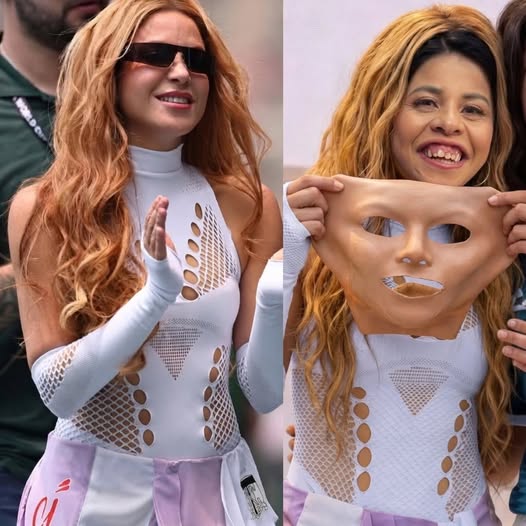
A shocking story began circulating on social media accompanied by images showing a woman apparently removing an extremely realistic-looking mask from her face.
The publications present the scene as the revelation of an alleged model or influencer who had spent months building a completely different identity using a hyperrealistic mask to modify her features.
The story quickly captured the attention of thousands of users.
Some reacted with surprise.
Others began to wonder to what extent current technologies allow a person’s appearance to be transformed.
Comments also arose about filters, artificial intelligence, makeup, prosthetics, and other resources capable of profoundly altering the image someone presents to the public.
However, there is one fundamental element that must be clarified from the beginning:
The viral text does not provide enough information to prove that a renowned international model actually deceived millions of followers for months using a mask.
The protagonist is not clearly identified.
No modeling agency is mentioned.
The name of the alleged international event does not appear.
There are also no verifiable statements, interviews, or documentation presented that would allow verification that it happened exactly as the narrative claims.
Therefore, it is more responsible to analyze the story as viral content related to the transformation of appearance and digital identity, without turning all its details into confirmed facts.
The image that sparked thousands of questions
The most striking element of the publication is the apparent facial transformation.
A woman appears holding in her hands what appears to be a mask with human features, while her real face shows considerably different characteristics.
The visual difference is enough to produce an immediate reaction.
For anyone who sees the image without context, the first question is usually:
Can someone really change their face that much using a mask?
The general answer is that there are silicone prostheses and masks capable of reproducing human features with a surprising level of detail.
These techniques have been used for decades in film, television, theater, professional characterization, and special effects.
The evolution of materials has allowed for a considerable improvement in the texture, coloration, and movement of this type of prosthesis.
But proving that a technology exists does not mean that the specific story circulating on social media happened exactly as it is told.
The difference between a striking image and a proven story
This is one of the main problems with viral content.
An authentic photograph can end up being accompanied by a fabricated story.
It can also happen that a scene belonging to an artistic, commercial or cinematographic demonstration is later presented as a real event.
The user observes the image.
Then read an explanation.
And it automatically connects both things.
But photography only shows what can actually be seen in it.
It does not necessarily demonstrate why the person was wearing the mask.
It does not allow you to know how long you used it.
It does not confirm that she was a well-known model.
Nor does it prove that millions of followers have been deceived.
To establish those details, it would be necessary to identify the origin of the image and locate independent information about the context in which it was taken.
What is a hyperrealistic mask?
Hyperrealistic masks are pieces designed to reproduce the features of a human face with great accuracy.
They are generally manufactured using flexible materials capable of mimicking the texture of skin.
Depending on the quality of the work, they may include:
Wrinkles.
Pores.
Pigmentation.
Facial hair.
Eyebrows.
Imperfections.
Changes in tone.
Anatomical reliefs.
When combined with makeup, proper lighting, and certain angles, some can produce visually very convincing results.
For that reason they are frequently used in audiovisual productions.
Cinema has been transforming faces for decades.
Long before social media, the film industry was already using prosthetics to completely alter the appearance of actors.
Makeup artists can add decades of age to a person’s face.
They can also modify the nose, jaw, cheekbones, forehead, and other structures.
Some jobs require several hours of preparation before recording begins.
What has changed in recent years is that certain tools and techniques no longer belong exclusively to large film studios.
There is a growing number of creators specializing in visual effects who are capable of producing impressive transformations for social media.
Digital identity can be much easier to modify.
If a physical mask can change the face, digital tools expand the possibilities even further.
Currently, a person can modify a photograph or video using filters capable of changing:
Face shape.
Skin texture.
Eye size.
Nose.
Lips.
Jaw.
Hair.
Even apparent age.
Some systems apply these modifications practically in real time.
This means that the appearance seen on a social media account can be very different from how a person actually looks off-screen.
Artificial intelligence changed the rules even further.
Generative tools have added a new dimension.
Today, images can be produced of people who never existed.
Real photographs can also be modified in an increasingly convincing way.
This represents new creative opportunities, but also new challenges.
When a person observes a surprising photograph, it becomes increasingly less advisable to automatically assume that they are seeing a completely authentic scene.
The question is no longer just:
“Is it edited?”
Now we must also ask ourselves:
“Was it generated?”
“Was it modified?”
“Does the story that accompanies it really correspond to the image?”
Is it possible to maintain a false identity for months?
In general terms, the internet allows the construction of identities that do not necessarily coincide with real life.
An account can use carefully selected photographs.
Filters.
Make-up.
Lightning.
Edition.
Avatars.
Even artificially created images.
However, maintaining a false identity permanently can be much more complex when there are public appearances, interviews, live broadcasts, and face-to-face contact with other people.
Therefore, such an extraordinary claim as that an international model deceived millions of people for months using a mask would require equally solid evidence.
The role of beauty standards
Although the specific story is not sufficiently documented, the debate it generates is interesting.
Social media has intensified exposure to certain ideas about beauty.
Symmetrical faces.
Flawless skin.
Defined bodies.
Perfect teeth.
Flawless hair.
Carefully lit photographs.
When a user constantly observes edited images, they may begin to interpret those results as completely natural.
That creates expectations that are difficult to meet.
The problem of comparing a real body with a constructed image
A professional photograph may require makeup, lighting, angle selection, and editing.
The user then views the result on their phone and compares it to their own everyday appearance in front of the mirror.
The comparison is unequal.
An image prepared for a campaign or publication does not necessarily represent how a person looks throughout the day.
Understanding this difference can help reduce some of the aesthetic pressure generated by digital platforms.
Would it be deception to use a mask?
The answer depends on the context.
Using a mask to create an artistic work, a character, or an audiovisual production does not necessarily imply deception.
The problem would arise if a person deliberately constructed a false identity with the intention of obtaining money, contracts, or benefits by taking advantage of a representation that conceals relevant information.
Even in that scenario, it would be necessary to analyze exactly what happened.
Not all cosmetic modifications constitute fraud.
Wearing makeup is not fraud.
Using filters isn’t automatic either.
Intention and circumstances are important.
Why does history generate so much fascination?
Because it plays with one of the oldest questions related to appearances:
What happens when we discover that what we saw wasn’t real?
The contrast between two completely different faces produces an immediate impact.
The audience feels they have witnessed a revelation.
This type of content works especially well on social media because it evokes several emotions simultaneously:
Surprise.
Curiosity.
Distrust.
Fascination.
Even fear.
The combination is perfect for generating comments.
“You can’t trust anything on the internet.”
That is one of the messages that frequently accompany this type of publication.
However, the conclusion needs nuance.
It does not mean that all content is false.
This means that it is advisable to verify what seems extraordinary.
Technology has increased the ability to modify images, but verification tools have also improved.
Find the origin.
Compare sources.
Locate previous publications.
Identify who appears.
Check if reliable media outlets documented the event.
All of these steps can help.
A public disclosure would need to leave traces
If an international model had actually revealed to journalists that she used a mask for months to deceive millions of followers, it would be reasonable to expect that numerous independent records would exist.
Videos from different angles.
Professional photographs.
Interviews.
Statements.
Press coverage.
Event identification.
Reactions from related agencies or brands.
When a story of enormous magnitude appears accompanied only by an image and a story without verifiable names, it is advisable to maintain a cautious stance.
Virality doesn’t make a story true
This principle keeps reappearing.
A post can receive a million reactions and still be incorrect.
The number of people who share a claim does not function as a verification mechanism.
Many websites replicate content because it generates traffic.
Then others copy the version.
Ultimately, it’s difficult to know where it all began.
The user ends up watching the same story ten times and thinks:
“If everyone is talking about it, it must be true.”
But all the posts could come from a single unverified source.
Shocking images are especially vulnerable to false context
When a photograph is already surprising on its own, it’s easy to add an even more spectacular narrative.
For example:
A makeup demonstration can turn into “a woman who cheated on her husband for years.”
A prosthesis used in film can be transformed into “a criminal who avoided being recognized.”
An artistic performance can end up being presented as “an influencer who deceived the world.”
The image may be real, but the added story is completely different.
Physical appearance does not determine a person’s worth.
Another problem with the original story arises when the face behind the mask is presented as a kind of “deception”.
That approach can actually reinforce the very beauty standards it is supposedly trying to criticize.
A person is not worth less for having irregular teeth.
A different nose.
Wrinkles.
Acne.
Scars.
Or any other physical characteristic.
If the reflection seeks to question society’s obsession with appearance, it is contradictory to ridicule the protagonist’s real appearance.
Authenticity also needs a definition
On social media, there is constant talk about “being authentic”.
But virtually all published content involves some degree of selection.
We chose a photograph.
We choose which moment to share.
We are looking for good lighting.
We edited a video.
The problem is not necessarily in presenting a polished version of ourselves.
The problem arises when that construction is used to manipulate or harm other people.
Technology and ethics will increasingly need to coexist
The coming years will likely bring even more tools capable of altering appearance.
More realistic masks.
Digital avatars.
Virtually undetectable filters.
Artificially generated video.
Synthetic voices.
All of this will make the question of digital identity increasingly important.
Platforms, users, and media outlets will need to develop better mechanisms to distinguish between entertainment, fiction, advertising, and real events.
What can be said about the viral story?
Based on the available text, it can be stated that a narrative is circulating about an alleged model who supposedly used a hyperrealistic mask.
It can also be said that the topic allows for discussion of the boundaries between appearance, technology, and identity.
What cannot be stated with certainty from the information presented is that a renowned international influencer deceived millions of followers for months and then publicly revealed the truth during a major gala.
To prove a story of that scope, additional sources would be needed.
A more interesting reflection than the supposed “deception”
The true value of the topic may not lie in determining whether a woman had a face considered more or less attractive.
The important question is another one:
To what extent do we trust what we see on a screen?
An image may have been staged.
A face can be filtered.
A scene may be out of context.
A person can play a character.
And an authentic photograph can be accompanied by a completely false story.
Digital literacy involves learning to live with that uncertainty.
Conclusion
The story of a supposed model who allegedly deceived the world using a hyperrealistic mask has sparked surprise due to the enormous visual contrast presented in the images circulating on the internet.
However, the available account does not provide enough verifiable data to confirm that an international influencer actually built an entire career using that false identity .
The protagonist is not clearly identified.
We do not know the alleged event where the revelation occurred.
No independent sources appear to document the deception.
Therefore, it is more prudent to treat the story as viral content whose full context needs verification.
What remains completely relevant is the debate it provokes.
Hyperrealistic masks, filters, prosthetics, digital editing, and artificial intelligence are profoundly changing the relationship between identity and appearance.
It is becoming increasingly easy to transform what other people see on a screen.
That doesn’t mean we should automatically distrust everything.
It means we need to learn to separate a striking image from a proven story.
Because in the digital age, seeing something with our own eyes no longer always means knowing the whole truth behind what we are looking at .
