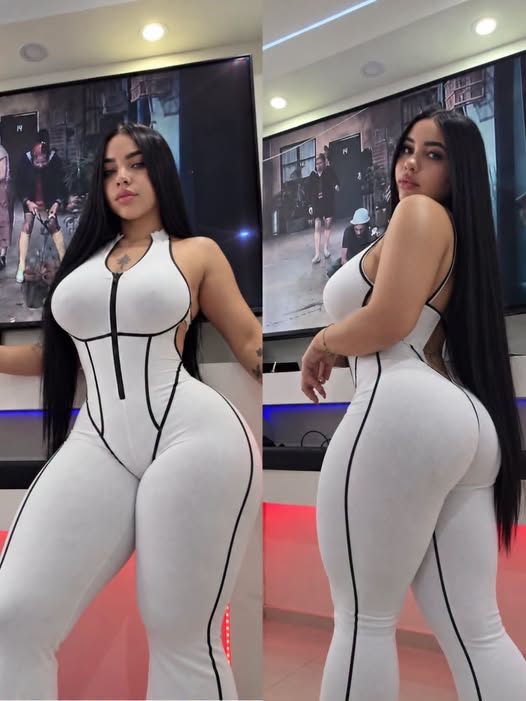
The Curves in a Woman’s Body Indicate That Her Confidence Comes in Many Forms
A woman’s body can naturally take many different shapes, and the image above highlights one of the body types that often receives considerable attention on social media. The caption, “The curves in a woman’s body indicate that her…”, may encourage people to complete the sentence with assumptions about personality, health, attractiveness, or even lifestyle. However, body shape alone cannot tell us those things. What it can show is simply that human bodies come in different natural proportions.
Curves around the waist, hips, thighs, and shoulders are influenced by a combination of genetics, skeletal structure, muscle distribution, body-fat distribution, age, and many other individual factors. Two women can have similar body weights while having completely different silhouettes. Likewise, someone’s body shape can change over time because of changes in activity, nutrition, hormones, aging, or other normal life circumstances.
The woman in the photograph is wearing a fitted white outfit with black lines that emphasize the contours of the clothing. The design itself creates strong visual contrasts, making the waist and overall silhouette particularly noticeable. This is one reason certain outfits can look dramatically different from one person to another. Clothing is not simply about covering the body; cuts, seams, patterns, materials, and proportions can all influence how a silhouette appears.
For many people, embracing their natural shape is connected to confidence and self-expression. Fashion can provide an opportunity to experiment with different styles without needing to fit into a particular definition of beauty. A fitted outfit, a flowing dress, athletic clothing, or casual jeans can each present the same person in a completely different visual way.
It is also important to separate appearance from assumptions about health. A particular body shape does not automatically indicate that someone is healthy or unhealthy. Visible curves cannot reliably reveal fitness level, medical condition, diet, fertility, personality, or lifestyle. Those characteristics require information beyond what can be observed from a photograph.
Social media often encourages quick judgments. A single picture may lead viewers to make assumptions about someone’s confidence, relationships, habits, or character. Yet photographs capture only a moment. Lighting, camera angle, posing, clothing, and even the lens used can change the way proportions appear. What we see on a screen is therefore not a complete picture of a person’s life.
The larger lesson behind the image can be about appreciating individuality. There is no single body shape that defines femininity, elegance, strength, or beauty. Some women naturally have pronounced curves, while others have straighter or more athletic silhouettes. All of these variations are normal.
Confidence also does not have one specific appearance. Someone may feel confident because of their fashion choices, their accomplishments, their personality, their physical abilities, or simply because they have become comfortable with themselves. A photograph can communicate confidence through posture and styling, but it cannot tell us everything about the person behind the picture.
Ultimately, the curves visible in a photograph indicate body proportions—not a person’s worth, personality, or complete story. The most meaningful interpretation is to recognize the diversity of human bodies while avoiding conclusions that cannot be supported by appearance alone.
