If Your Partner Makes You These “Chu…” Marks, There’s More to the Story Than Romance
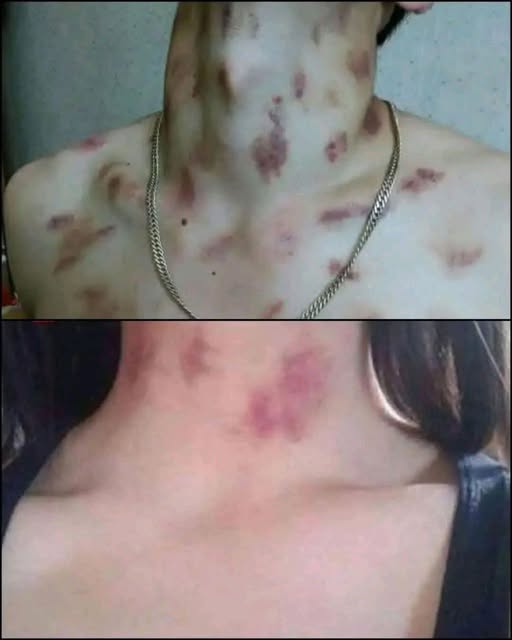
The image above shows visible reddish and purple marks around the neck, shoulders, and upper chest. Many people immediately associate marks like these with “love bites” or hickeys, but it is important to remember that a photograph alone cannot tell us exactly how these marks were caused.
A “love bite,” commonly called a hickey, can occur when suction or pressure causes tiny blood vessels beneath the skin to break, leaving a temporary reddish, purple, or dark mark. The appearance can vary depending on a person’s skin, the amount of pressure involved, and how long the mark has been present. Some marks may fade within several days, while others can remain visible longer.
However, when marks are extensive, painful, unusually dark, or appear alongside other injuries, they should not automatically be treated as a sign of affection. Injuries around the neck can have many causes, and some can be more serious than an ordinary bruise.
The most important issue in any relationship is consent and respect. Physical affection should always be something both partners are comfortable with. A person should never feel pressured, frightened, threatened, or forced into physical contact simply because they are in a relationship.
Sometimes social media posts present dramatic bruises or neck marks as evidence of intense romance. While that may attract attention, real relationships are more complicated than a photograph or viral caption. A mark on someone’s body does not prove that a relationship is passionate, healthy, unhealthy, abusive, or loving. Context matters.
If someone deliberately causes painful marks after being asked to stop, ignores boundaries, or uses physical force during an argument, that is a different situation from consensual affection. Repeated unwanted physical contact can be a serious warning sign.
It is also worth remembering that people can have different boundaries. One person may be comfortable with visible marks, while another may strongly dislike them. Neither preference needs to be judged. Healthy partners communicate about those boundaries before and during physical intimacy.
For anyone who discovers an unexplained bruise or injury, paying attention to other symptoms is important. Severe pain, swelling, difficulty breathing or swallowing, dizziness, fainting, confusion, voice changes, or rapidly worsening symptoms—particularly after pressure or injury to the neck—can require urgent medical attention. Neck injuries can sometimes be more serious than they appear on the skin.
There is also an emotional side to this topic. Someone who feels embarrassed, afraid, or uncomfortable about marks caused by a partner should not feel that they have to hide their feelings. A caring partner should listen when someone says “stop,” “that hurts,” or “I don’t want that.”
Love should never be measured by how painful, dramatic, or visible a mark is. Genuine affection is shown through communication, trust, respect, and consideration for another person’s boundaries.
So, if you see a photo like this online, don’t immediately assume you know the story behind it. A picture captures only one moment, and appearances can be misleading. Instead, it can serve as a reminder that consent matters, boundaries matter, and unexplained or painful injuries deserve attention rather than being automatically romanticized.
What looks like a simple “love bite” in a viral photo may have a very different story behind it. The healthiest relationships are the ones where both people feel safe, respected, and heard.
