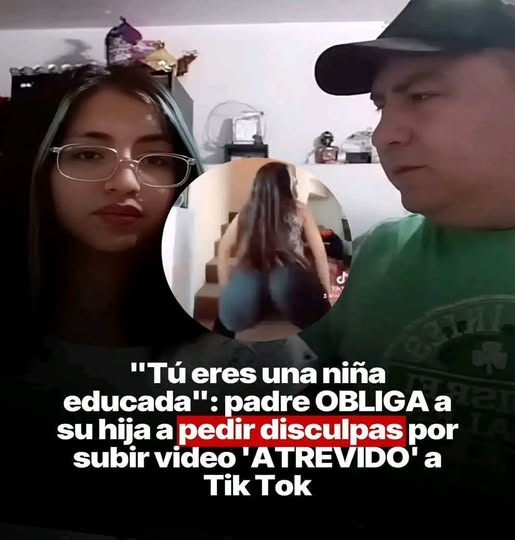
Padr3 forces his daughter to apologize for TikTok videos and data…see more
Father Forces Daughter to Apologize for TikTok Videos: A Debate About Parenting and Social Media
A video circulating on social media has sparked a heated discussion about parenting, teenage behavior, and the growing influence of TikTok. The clip appears to show a father confronting his daughter and asking her to apologize after she posted what he considered an inappropriate or overly provocative video on the platform.
The situation has quickly attracted attention because it touches on a question many parents face today: How much control should parents have over what their children post online?
In the image, the father appears to be speaking seriously while his daughter sits beside him. A smaller video shown in the middle of the image appears to feature a young woman recording a TikTok-style video. The Spanish text over the image says, “Tú eres una niña educada” and describes a father obliging his daughter to apologize for uploading an “atrevido” video to TikTok. The word “atrevido” can suggest something daring, bold, or provocative depending on the context.
Although short clips and screenshots can quickly go viral, viewers should remember that social media posts often provide only a small part of the story. Without knowing the complete circumstances behind the video, it is difficult to determine exactly what happened between the father and daughter, why the father reacted so strongly, or what was said before and after the recorded moment.
Nevertheless, the incident has opened a broader conversation about how families should deal with social media.
For many parents, TikTok and similar platforms can be difficult to understand. Young people often see social media as a place for entertainment, creativity, self-expression, and communication with friends. Parents, on the other hand, may be more concerned about privacy, strangers, inappropriate comments, online reputation, and the possibility that a video could spread far beyond its original audience.
Once something is posted online, controlling where it goes can be extremely difficult. A video that receives only a few views today can potentially be copied, downloaded, reposted, or shared with thousands of people tomorrow. This is why some parents believe they have a responsibility to teach their children to think carefully before posting.
At the same time, many people argue that communication is more effective than simply forcing a child to apologize. Teenagers are still developing their judgment and learning how to understand the consequences of their decisions. A calm conversation about boundaries, privacy, respect, and digital responsibility may help them understand why certain content could create problems in the future.
There is also an important difference between guidance and control. Parents naturally want to protect their children, but young people also need opportunities to develop independence and learn from their mistakes. Finding that balance can be challenging, especially when social media is involved.
Another issue raised by the video is the pressure young people can feel to create attention-grabbing content. On platforms driven by views, likes, shares, and followers, creators may feel encouraged to make increasingly bold videos simply because controversial content often attracts attention. What begins as a harmless trend can sometimes become something that creates embarrassment or conflict at home.
Parents therefore have an important role in helping their children understand that popularity online should not come at the expense of personal safety, privacy, or dignity.
However, the responsibility does not belong only to parents. Young people also need to understand that posting online comes with consequences. Before uploading a video, it can be useful to ask: Would I be comfortable if my family, teachers, classmates, or future employer saw this? If the answer is no, taking a moment to reconsider may be wise.
The viral father-and-daughter moment also demonstrates how quickly family disagreements can become public entertainment. A private disagreement can suddenly be watched, discussed, criticized, and shared by strangers around the world. That can create another layer of pressure for everyone involved.
Ultimately, the story is bigger than one TikTok video. It is about the challenges families face in an era where smartphones and social media are part of everyday life. Parents want to protect their children, while young people want freedom to express themselves.
The best solution may not be simply banning social media or forcing someone to apologize. Instead, families can benefit from honest conversations, clear boundaries, mutual respect, and education about digital responsibility.
Social media may change rapidly, but one lesson remains important: before posting something online, think carefully about whether you are ready for the possibility that it could be seen by people you never expected to see it.
What do you think? Should parents have the right to make their children apologize for social media content they consider inappropriate, or should teenagers be given more freedom to decide what they post?
