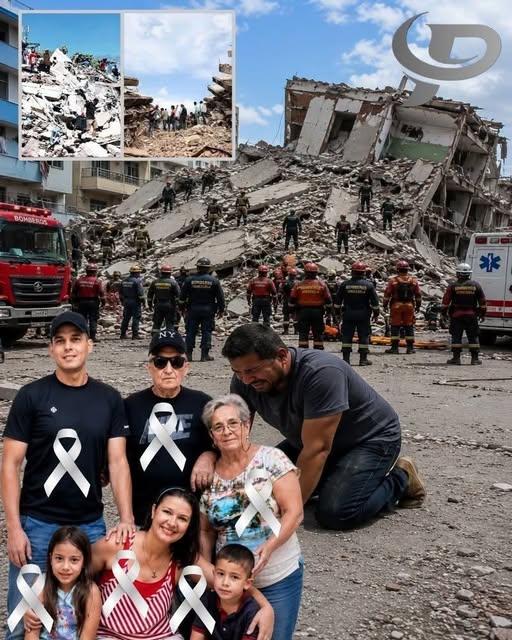
After 43 days of searching, a family finally received news of six loved ones who had disappeared in La Guaira.
For 43 days, uncertainty became part of the daily life of a family desperately seeking answers after the devastating earthquakes that shook Venezuela on June 24.
The story, which circulated on social media and in media outlets linked to the Cuban community, features Mabel Hernández , described in those reports as a Cuban citizen residing in Venezuela who was searching for six members of her family after the collapse of a building in the state of La Guaira.
According to those publications, among the missing were his parents, his brother, his sister-in-law, and his nephews.
For more than six weeks, Mabel reportedly used social media to keep the search active, request information, and ask that the work among the rubble continue.
Finally, on August 6, the news arrived that put an end to that wait: the six family members were located and identified, according to the reports released about their case.
The confirmation marked the end of a search, but also the beginning of a completely different stage for a family deeply affected by one of the most serious natural disasters recently recorded in Venezuela.
It all started on June 24th
The overall scale of the tragedy is indeed widely documented.
On June 24, 2026, Venezuela was struck by two consecutive earthquakes of magnitudes 7.2 and 7.5 , occurring less than a minute apart. La Guaira suffered severe damage and saw multiple buildings collapse.
Images that began circulating in the following hours showed completely destroyed structures, streets covered in debris, and emergency teams trying to locate survivors.
The situation was especially serious in parts of La Guaira.
NASA later used NISAR radar data to study the ground surface displacements caused by the earthquakes and noted that these were particularly intense near Caracas and La Guaira.
For thousands of families, however, the tragedy could not be summed up in maps or figures.
Behind every destroyed building, there were people waiting for news.
La Guaira was among the most affected areas
From the first hours of the emergency it was clear that La Guaira was facing an extraordinarily complicated situation.
The Pan American Health Organization indicated in its first report that there were multiple collapsed buildings and search and rescue operations underway.
Later, satellite images showed the magnitude of some of the landslides.
Entire sectors began receiving rescue teams, volunteers, and humanitarian aid.
But removing the remains of large buildings could not be done immediately.
Each structure presented a different challenge.
The search for a family among tons of rubble
According to the account released about Mabel Hernández, several of her relatives were inside a building in Naiguatá when the disaster occurred.
After the collapse, a search began that would end up lasting for weeks.
To understand what 43 days of waiting for information means, just imagine the uncertainty of waking up every morning not knowing if that would finally be the day that some answer would appear.
During an emergency of this magnitude, the first few days usually receive the most attention.
Then the weeks come.
The cameras begin to leave.
Public discourse is declining.
But the families continue to wait.
The search for missing persons does not end when the cameras disappear.
One of the great lessons that natural disasters teach us is precisely this.
The emergency can last much longer than the media attention.
During the first few days after the Venezuelan earthquakes, thousands of people participated in rescue operations, humanitarian aid, and the search for missing persons.
Civil society also played a considerable role, organizing food, medicine, transportation, and search networks for people still trying to locate relatives.
Meanwhile, families needed to continue providing photographs, names, and any information that could contribute to an identification.
Why can it take so long to recover people from a building?
A collapsed building does not simply become a pile of materials that can be quickly removed.
The different plants can fall on top of each other.
Columns, walls, furniture, pipes, and metal structures are compressed into extremely small spaces.
Moving a piece incorrectly can cause further displacements.
That’s why specialized teams need to constantly study the stability of the site.
In certain circumstances, heavy machinery may be used.
In others, the work needs to be done much more slowly.
The initial priority is to locate survivors.
Over time, operations have also focused on recovering and identifying those who lost their lives.
Identification represents another process
There is also an important difference between finding remains and officially confirming a person’s identity.
Depending on the conditions, different forensic procedures may need to be performed.
Families can provide information that facilitates identification.
Scientific methods can also be used in complex situations.
This procedure seeks to reduce the risk of giving incorrect information to a family that has been waiting for days or weeks.
Therefore, even after a discovery, it can take time to get a definitive answer.
Social media became a fundamental tool
After major emergencies, Facebook, Instagram, TikTok, WhatsApp, and other platforms can quickly transform into huge information networks.
Family members publish photographs.
They share names.
They indicate where a person was last seen.
They ask about hospitals and shelters.
They ask for information from strangers.
Sometimes, these publications allow people to connect who would never have had contact through other means.
But there is also a danger.
Rumors can cause even more suffering.
During a catastrophe, incorrect information inevitably appears.
Someone claims to have seen a person in a hospital.
Another user shares a photograph without verifying it.
An old publication reappears as if it were recent.
A name is misspelled.
And a desperate family can travel miles chasing information that was never true.
Therefore, although social media can be extremely useful, final confirmation must come from verifiable sources and the agencies responsible for searches and identifications.
43 days represents more than six weeks of uncertainty
In the widely publicized case of Mabel, the figure that ended up attracting particular attention was 43 days .
More than six weeks.
During that time, the family would have continued to wait for the recovery of six loved ones.
Such a prolonged search can produce enormous psychological strain.
The person does not have a definitive answer.
There is pain, but also uncertainty.
Each call can cause anxiety.
Every new piece of news about a recovery can simultaneously awaken hope and fear.
When the search ends, another reality begins.
According to reports on this case, on August 6th the confirmation that Mabel had been waiting for for weeks finally arrived.
The six family members have reportedly been recovered and identified.
Finding them couldn’t change what had happened.
But it meant putting an end to a question that had remained open for 43 days.
In situations of disappearance after catastrophes, obtaining an identification also allows families to begin the farewell procedures.
And that stage can be equally difficult.
Grief after a disaster has particular characteristics
Losing a family member is always a painful experience.
But when the loss occurs during a collective catastrophe, additional difficulties may arise.
The house may also have disappeared.
The documents may have been lost.
Other family members may be injured.
It may be necessary to relocate.
Public services may be affected.
Furthermore, thousands of people are simultaneously going through similar situations.
The family not only tries to emotionally process a loss, but also to reorganize virtually their entire life.
The story also reached the Cuban community
Mabel’s case sparked additional interest due to her Cuban origin.
According to reports about the family, after the search ended, they began making arrangements to say goodbye to their loved ones, including the possibility of transferring their parents’ ashes to Cuba.
These kinds of circumstances reveal another reality of modern disasters.
Migrant families may be scattered across different countries.
When a tragedy occurs, needs arise related to consulates, documentation, transfers, and family decisions that must be made in the midst of grief.
The Venezuelan tragedy was enormous
The earthquakes of June 24 left widespread destruction.
Days after the disaster, the official death toll continued to rise as teams continued working in different affected areas.
On June 29, for example, 1,719 deaths had already been reported.
By the end of June, authorities had again raised the death toll and emergency operations were continuing.
The figures allow us to understand the magnitude.
But stories like this family’s show the human dimension behind those numbers.
Six people are not simply six names
When the statistics of a tragedy begin to grow, there is a risk that the victims will end up becoming just numbers.
One hundred missing.
One thousand wounded.
Thousands dead.
But for a family, a single person represents a whole story.
In this case, they were talking about parents, siblings, a sister-in-law, and nephews.
Each relationship meant years of memories, celebrations, conversations, and projects.
That’s why a 43-day search cannot be understood solely as a rescue operation.
For those who wait, it practically becomes the center of their entire existence.
The volunteers were also essential
After the earthquakes, numerous citizen initiatives emerged.
People who did not belong to official organizations began transporting food, clothing, and medicine.
Others helped search for missing persons.
Digital networks also emerged, designed to organize information.
El País documented how Venezuelan civil society organized convoys, community kitchens and aid mechanisms in different affected sectors.
In an emergency of this magnitude, coordination between authorities, specialists and communities can be crucial.
The reconstruction will take much longer than the search.
Although rescue operations eventually end, the consequences of an earthquake can last for years.
The homes need to be rebuilt.
Damaged buildings must be assessed.
Schools need to resume their activities.
Basic services must be restored.
Displaced families need to find a place to live.
In La Guaira, the Government later estimated that some 30,000 people were in the particularly impacted areas of Caraballeda and Catia La Mar at the time of the earthquakes.
Physical reconstruction represents only one part.
There is also an emotional reconstruction.
The importance of maintaining records of missing persons
Large-scale disasters demonstrate why centralized information systems are essential.
The same person may appear reported by different family members.
Someone considered missing may be found hospitalized without documentation.
Name errors can also occur.
Maintaining up-to-date databases helps reduce these confusions and facilitates the exchange of information between hospitals, shelters, forensic agencies, and families.
What can a family do during a search?
In disaster situations, it is useful to keep recent photographs and identifying information of the missing person.
It is also important to maintain communication with the responsible authorities.
When possible, centralizing information through one or more family members can reduce rumors and contradictions.
Social media posts can complement that search.
But they shouldn’t replace official channels.
The viral image doesn’t necessarily tell the whole story either.
Another important aspect is to differentiate a documented history from the images used to represent it.
On social media, it is common to find montages where family photographs appear placed over images of destroyed buildings.
This does not necessarily mean that the story is false.
But it also doesn’t mean that the photograph of the building corresponds exactly to the place where the family was located.
That’s why each element needs to be verified independently.
A striking image does not constitute a source in itself.
What we do know about the catastrophe
It is confirmed that Venezuela suffered two earthquakes of magnitude 7.2 and 7.5 on June 24, 2026.
It is confirmed that La Guaira was one of the regions especially affected and that numerous buildings collapsed.
It is also documented that the search and rescue operations extended far beyond the first few hours of the tragedy.
These elements provide the real context in which the widely circulated story about Mabel and her family is situated.
Personal details require extra caution.
In contrast, names, family relationships, exact recovery dates, and subsequent family decisions need to be supported by specific sources.
Therefore, until these details can be sufficiently verified through accessible and independent sources, it is correct to attribute them to the reports that disseminated the story , rather than presenting them as information confirmed directly by Venezuelan authorities.
That difference may seem small, but it is fundamental in a journalistic report.
A tragedy doesn’t need exaggeration to move us.
The earthquakes of June 24 already represent an extraordinarily serious tragedy.
It is not necessary to add unconfirmed details to increase the impact of a story.
The reality of thousands of families searching for loved ones, displaced people, and destroyed communities carries enough weight on its own.
Precisely out of respect for the victims, every name and every story should be handled with care.
A wait that symbolizes many other families
Although attention is focused on one particular case, the experience of waiting for news after a disaster was shared by many other families.
Some received answers quickly.
Others had to wait days.
And some continued searching for weeks.
Behind every search lay the same fundamental need:
to find out what had happened to a loved one.
Conclusion
The story of Mabel Hernández and the 43-day search for six members of her family has become one of the accounts that reflect the enormous human impact left by the earthquakes that shook Venezuela on June 24.
The general catastrophe is widely documented: two earthquakes of magnitude 7.2 and 7.5 struck the country less than a minute apart, causing serious damage and numerous casualties, especially in Caracas and La Guaira.
According to reports about the case, the search for the six family members ended on August 6, 43 days after the disaster, when they were finally recovered and identified.
However, those specific family details must continue to be attributed to the publications and media outlets that have reported the story until there is accessible official documentation that allows each element to be independently corroborated.
Beyond that, the case reflects an undeniable reality of any major disaster: for families, a tragedy does not end when it disappears from the headlines .
It can continue for days, weeks, or even months.
It continues as long as someone is missing.
Continue as long as a family is waiting for a call.
And it continues long after finding answers, when the difficult process of saying goodbye, rebuilding, and learning to live after a loss begins.
The story also offers a lesson for those who share information during an emergency: helping also means verifying before posting .
Because for a family that has been waiting for news for weeks, false information is not simply an internet error.
It can become a new hope that then breaks again.
